Wednesday, July 15, 2015

The Flight of the Honeybees


The excitement of receiving the new package bees quickly turned to disappointment at the Lazy Duck. After only two days, the new package bees were gone. "Absconded" is the term used in beekeeping when bees abandon their hive. To us, it was a big blow. One afternoon they were there, the next morning, they had absolutely vanished. If not for a few dead bees remaining in the box, and some slightly established comb, you wouldn't have even known they were there. It was heartbreaking.

Nobody really knows why bees abandon their hive, but we learned the following things (after the fact) related to successfully installing package bees in a new hive:

  1.  Always install the package in the evening. Bees don’t leave their hive at night and this allows them to become familiar with the hive and begin installing their scent before they begin scouting out the area.
  2. When installing a new package, if at all possible put them in a hive with at least one frame of established comb. This gives them a bit of a head start in having a place to put new pollen when they begin working before the queen is released from her cage. If there is hive with pollen and comb when she is released, it encourages the queen to begin laying eggs. When eggs are laid, the bees are more likely to stay as they will not abandon brood.
  3. If possible, transfer a frame of brood from another hive to the new hive. This goes along with #2, in that bees will not abandon brood.
  4. Put in something known as a queen keeper under the bottom frames for 1-2 weeks after installing the package, which allows the workers to come and go, but has openings too small for the larger queen to pass through. Since the bees in a hive follow the queen, if the queen can’t leave the hive, the bees won’t, either. This encourages the queen to stay and begin laying eggs and, as we know from #2, the bees won’t abandon their brood.

This has been an expensive lesson for us, as the package bees cost $150. Now our second hive boxes sit empty until we can either catch a swarm from our first hive or until we purchase another package or swarm next spring. 

Our established hive is working away. We are pretty certain the hive swarmed. This means they grew a new queen and kicked out their old one. When she left, she took half the worker bees with her. We were not able to recover that swarm. The new queen began laying after about a week. The honey that was built up was cleared out some, we suspect to make room for new brood. As summer progresses, they are left to do their work. They've visited the many blooms that have sprung up around the property, pollinating and doing all the normal honeybee activities. They have a few more months to build up their stores for winter, and in the meantime we simply monitor their progress.

Tuesday, May 26, 2015

I Picked a Peck of Pickled... Radishes?


With my radish crop becoming ripe, I found myself with more radishes than I could possibly consume on my own. The best way I could think of to extend the life of my produce was to pickle them. Last night I did just that.


I first harvested all the radishes. There were a handful that were still too small, and may never full develop, but the yield from my twelve square feet of garden (after having already picked enough for a snack and a side dish) was well over 100 radishes. And I still have time to replant in that same square footage, if I wanted (and I probably will). Those hundred radishes resulted in 7 jars of pickles, with three of those having carrots mixed in. It would have been six 16 oz. jars of all-radish pickles.


I decided to try a couple different recipes, since I have no clue what the result would be. Naturally, I turned to pinterest and found two promising variations. One was a basic pickle, using apple cider vinegar and honey. The other was a more Asian style using rice vinegar and sugar.


I began by prepping all my radishes, removing the greens and roots. The chickens and goats seemed to enjoy those, so there is no waste! Then I sliced all the radishes to about 1/8" thickness using my mandolin, which made them nice and consistently sized, and saved me a bunch of time, I'm sure. Radishes are so small that it was a little difficult to use the hand guard thing, but I've watched enough food network to know you should never use a mandolin with your bare hands.


For the first recipe, courtesy of gardentherapy.ca, I stayed pretty true to the recipe except I used pickling salt instead of sea salt. I'm hoping the amounts required to get a good brine are pretty consistent between those two.


For the more Asian version, I modified slightly a recipe I found on the Whole Foods website to use ingredients I had on hand. Those jars contain a mixture of 2/3 radishes and 1/3 carrots. I omitted the cucumber, chilies, ginger, and onion - all of which would make them way more delicious but I didn't have the foresight to pick them up at the store. Next time! I also played with the pickling juice a bit and tested three variations:

  1. Rice vinegar and pickling salt
  2. Seasoned rice vinegar and pickling salt
  3. Seasoned rice vinegar and pink Hawaiian salt

They are in the fridge now, since both recipes are considered "quick pickles" and are not meant for long term storage. They should be ready to try by tomorrow! I'll report back with the results. fingers crossed!


Saturday, May 23, 2015

Everything's Coming up Radishes


Establishing a new farm takes a lot of patience. Waiting for the seasons to change, baby animals to grow, and gardens to start producing a bountiful harvest all require a huge investment of time and energy before there is any tangible reward. At the advice of our local Ag Extension office, I planned to get the seeds in the ground for our garden on or around April 15th. Well, mother nature had a different plan and dumped two weeks of rain on us right when I'd hoped to plant. Once the rain cleared and I was able to till the garden patch, the seeds finally went in the ground, right at the end of April. And then I waited. With no previous experience with the local soil, and never having planted a garden this big or varied, I have no idea what to expect.

Our garden has somewhere around 70 varieties of produce planted, the bulk of which are seeds from a kit we purchased a while ago that was intended as something you could keep stored in the event of societal collapse ... or if you just wanted a crap ton of seeds that were heirloom varieties. Because the kit came pre-assembled, it included many items I would have probably passed over when browsing the seed racks at the local shop, such as Swiss chard or radishes. Radishes have never held much of an appeal to me. I have never scooped a single radish on to my plate at the salad bar. I'm not sure why, perhaps just ignorance. But into the ground radish seeds went, figuring what the heck, if nothing else I'd find a radish-loving neighbor.


Lo and behold, the first green sprouts to show their leafy faces, were the radishes. They grew quickly and plentifully. I checked my notes, and realized the radish takes only 21-28 days to mature. Which means, a month into my garden I've already had my first harvest! I sampled some of the young radishes, which were so surprisingly tender and moist. I ate those sliced with some salt, and when I shared photos of my small bounty, my friends asked what recipe I would be preparing. Recipe? You mean radishes can be used for something other than salad garnish? A quick scan of pinterest revealed a slew of options for these mysterious quick-growing root vegetables.


Tonight I pulled a huge bunch of radishes fresh from the garden. Tom wanted to grill, and I didn't have time to run to the store to pick up corn or potatoes, or another staple grilling accompaniment. I know that anything you roast you can just ass easily do in a foil packet on the grill, Radishes aren't all that different from potatoes, right? 


I washed the bunch of radishes, removed the roots and greens, and quartered them. I tossed the radishes in the foil packet with a drizzle of olive oil, some salt and pepper, and a sprinkling of garlic powder for good measure. I decided to keep it simple since I had no clue what a cooked radish tasted like.  It turns out it's reminiscent of a beet crossed with a Brussels sprout. The cooking cuts the inherent spiciness of the radish but imparts a certain... earthiness? Anyhow, I recommend this recipe if you want to try a little something different. I feel a little silly writing out the actual recipe since it's so ridiculously easy, but here ya go:


Grilled Radish Packets

1 bunch radishes (about 14)
Olive oil
Salt & Pepper to taste
Garlic powder or other seasonings

Remove roots and greens from radishes and quarter. Place on a large sheet of heavy duty foil. Drizzle with olive oil and sprinkle with spices. Close foil packet up securely. Place on the upper rack of a hot grill and cook for 15-20 minutes until tender.

Enjoy!

Tuesday, May 12, 2015

Today we had a package at the post office - A Package of Bees!


Today our second colony of bees arrived! Back in February we reserved our bees from Kelley Beekeeping – with May 9th being the earliest ship data available. (We learned too late that December or January is the best time to order to secure an early spring delivery.) The bees arrive via USPS and must be picked up at the local post office. Early his morning Tom received a call that our new friends had arrived. Living in the country, our post office is not alarmed by the arrival of the small, screened wooden crate that the bees are shipped in. We went to collect our bees and brought them home to be installed straight away.

knock knock!


It was a bit of a blessing that our first hive, well established, arrived at the lazy duck ranch weeks ago. This gave Tom a chance to grow comfortable with handling the bees before having to undertake what had seemed like the daunting task of transferring bees from the shipping box to the hive.  


Tom began by “smacking the package smartly against the ground” to knock the bees to the bottom of the box (per the instructions on the youtube video he watched to refresh himself before undertaking the installation.) He then removed the cover and extracted the feeder that kept the bees nourished in transit. He located the small box that contains the queen and set it aside. The package with the bulk of the bees was upended into the hive, from which several of the honeycomb frames had been removed.

smack smartly on the ground
safety first


The small box containing the queen was next to be introduced – she was held in place with a cork and a candy plug. Her hivemates will eat away the plug until she is released from the box and into her new home. Keeping her contained in the hive is important to helping them accept their new home. The colony of bees follows its queen. Our purchased queen bee has been marked with a dot so she may be easily located when she is in the hive. After three days, Tom will reopen the hive to verify that the queen has settled in to her new home and the colony has begun producing comb in the now vacant frames.

the queen has a white dot painted on her.


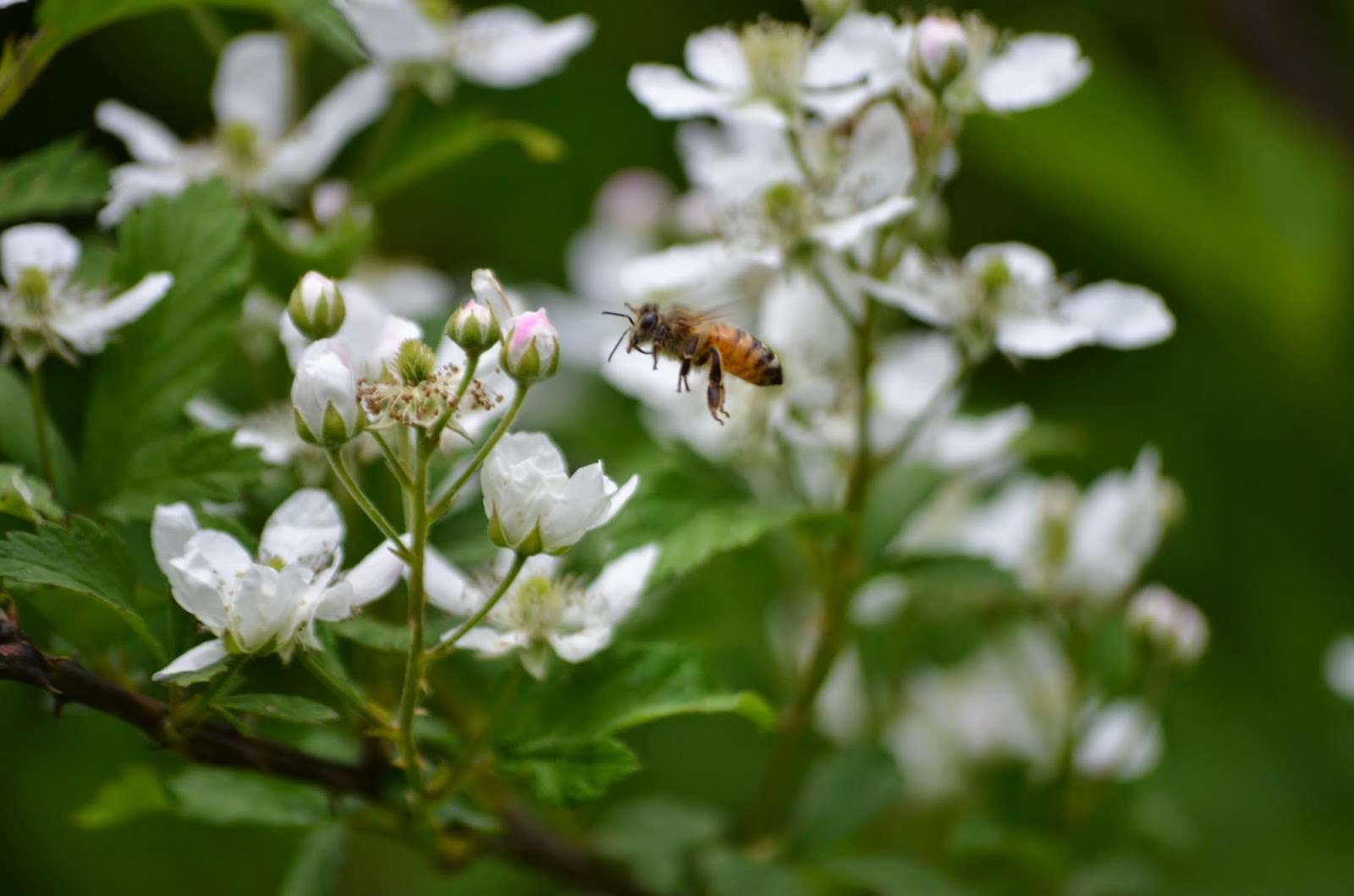
This new colony of bees has its work cut out for it to establish a store of honey to sustain them through the winter. For now, they will be supplemented with a feeder of sugar water to ensure they have are maximizing their production. Fortunately, the farm is also in full bloom with plants the bees appear to love. We've seen the bees on the blossoms on our rose, mock orange and blackberry bushes, the American holly tree, and countless other plants around the property. Their buffet also includes clover, dandelions, peonies, and soon, honeysuckle and the extensive bounty of our garden.


While our package bees are just starting out, the established colony we received has already begun to fill up the few empty honeycomb frames in the first brood box we set out. Tom added a second deep super on top of the first to allow them to expand their empire. The colony requires two deeps to last the winter, anything from additional supers on top are what we will harvest. All that jargon! Here’s a diagram to help explain.

two hives in action!


Friday, April 24, 2015

The bees are here!

Our first colony of bees has arrived at the Lazy Duck Ranch, and they are already working on pollinating around our place! We spotted some of our bees enjoying a patch of yellow blooms in our yard today. Tom was very excited to see the bees out doing their thing, as it indicates a healthy hive.
The gentleman who provided us with the swarm that came as part of our bee club raffle prize package let us know our hive was inhabited and ready for pickup on April 12th. He provided us with an established hive rather than a swarm. This meant that 70% of the frames that make up the first level of the hive were already full of honey comb. This is good news because that means they already have a good start on building their stores for next winter and chances are better that we might have a little surplus honey to enjoy ourselves this fall.

Tom is getting used to suiting up to check on the hive, and is working to overcome that innate fear of being surrounded by creatures who could, if they so desired, inflict great pain. A bee inside his veil didn't help ease the transition.

Within a few days of the hive's arrival, it was overrun by ants in search of the sweet honey. Tom did his research and employed a combination of methods to deter the ants, including lifting the whole setup onto cinder blocks and putting cinnamon sticks, which break up the ant's scent trails, between the stand and the hive..
Tom proudly wears his RightStar shirt, the perfect attire for beekeeping.
Our second bee colony arrives in a couple weeks. Time to get the second hive ready for them, and get prepared to install the queen in her new home, all on our own!

Monday, April 6, 2015

Baby Led Weaning: An Introduction


I recall being at a barbecue, about 1 year B.C. (before children) and seeing my friend Kristen's young daughter toddling around in adorable cloth diapers, munching on a stalk of raw broccoli. I was flabbergasted. Cloth diapers in 2012? Babies eating food that wasn't pureed into an unidentifiable mush? I immediately began peppering her with questions. How I adopted her cloth diaper ways is a story for another post, but I was intrigued to learn from her about this thing called Baby Led Weaning. I learned that babies, from a very early age, can eat a variety of whole food, and THEY LIKE IT! You mean I didn't have to wash blender parts, prepare 87 different recipes, or drop a small fortune in the baby food aisle to make sure my kid was getting the best food out there? Sign me up!

I did my research once The KLAW was born, and we decided to give this BLW stuff a try. I love talking about our experience with it, and find myself sharing tips over and over within my mom groups. My friend Darcy challenged me to write a blog post on the topic, and I thought it was a great idea. Not only could I reach more people, it would save me from retyping the same way-too-long facebook posts every few weeks.

Very Hungry Caterpillar
Please note: I've had one child. His personality and developmental curve led themselves to BLW. He tried everything I offered him, so much so that his first birthday had a "Very Hungry Caterpillar" theme. But remember: Every baby is different. YMMV. I hope you can use these tips, but please don't despair if your experience with your own child isn't the same as ours. As long as your kid is reasonably healthy (peeing, pooping, growing), you're doing great. And if your kid is fed a pouch or a puree - don't panic! Your kid is not broken! It's not worth ruining Christmas because a well-meaning Grandma thought little Jimmy looked hungry and needed some nom noms and shoved mashed banana in his face with a spoon.

First, what exactly is Baby Led Weaning? In my experience, it has absolutely nothing to do with weaning. The KLAW is still nursing many times a day, but also loves to eat solid food. It should be called Baby Led Food Introduction, in my opinion. Basically, you take cues from your child as to what they are ready to try in terms of solid food, and introduce accordingly. They are fed table foods, just like mama and dada eat, complete with seasonings and (unless it is a normally pureed/soft food like applesauce or mashed potatoes) they are served in easy to handle pieces. The child is offered the food, and eats as much as he wants. This supposedly teaches portion control and reduces obesity later in life. I found that some days The KLAW could put away an entire small chicken breast with some sides, and other days would rather feed the whole thing to the dog. Remember, for kids under one, food is for fun. Most of their nutrition is still coming from breastmilk or formula.

Happy to share
Signs of Readiness

This Cheeto is delish.
The signs your child is ready for solid table food become pretty obvious. He should be able to sit up, even if it's with some support in a padded high chair or bumbo. He should be showing an interest in what you are eating. We knew The KLAW was ready to start on solids when, at five months old, he grabbed a Cheeto out of his daddy's hand and started chomping on it happily. The next two signs are a kind of chicken/egg situation. The skills will start out rudimentary, but improve quickly with practice eating. The baby should be able to pick up an object in his fist, put it in its mouth, and gnaw on it. At first your kid might stab himself in the eye with a zucchini spear, then take a nibble and immediately eject it from his mouth with his tongue. NORMAL. He's learning. This will improve quickly. One difference between BLW and spoon feeding is that with BLW a baby learns to chew, then swallow, whereas with purees, the baby learns to swallow, then chew.

Next, he might get the food to the back of his mouth, but gag, and maybe even throw up. Traumatic, but again, NORMAL. Gagging is not choking. Your baby might choke on any number of food or non-food items. Knowing the baby Heimlich is important. But if your kiddo is trying to down a delicious piece of asparagus and suddenly looks and sounds like he's hacking up a hairball? Yeah, that's gagging. NORMAL. Look up BLW videos on YouTube to see what to expect. Soon your kid will go from grasping his food like a microphone to being able to pick up small pieces with his fingertips using a pincer grip. At this point your options for self-feeding increase dramatically. I honestly think that BLW helped The KLAW develop really great manual dexterity.

The KLAW was a dental prodigy from an early age. He cut his first teeth at 5 months, and is currently working on his two year molars (the final four baby teeth) at 18 months. While I think this helped speed along his affinity for solid foods, you would be freaking amazed what these little tykes can gum. The KLAW was eating bits of steak with two or four teeth. So if your child is showing all the other signs of being ready for food, don't let his gummy smile hold you back! Fun fact: Cold, raw foods with soothing properties (like cucumber) can provide teething relief, as can frozen fruits (such as grapes) offered in a mesh teether.

Pickles are delicious and feel good on my swollen gums
Allergies

Introduce new foods with caution, one food every three days or so to make sure there are no allergies. There is so much literature out there about allergies, all conflicting. Introduce peanuts too early, your child will have a peanut allergy. Don't introduce them early, your kid will have a peanut allergy. Who knows. We have no family history of food allergies, and no reason to believe our kid had any sensitivities based on the foods he received second-hand from my breast milk. So we stuck to the three day rule for a couple weeks, then just let him try whatever. I kept a list of foods he tried, so that we could back out what he might have reacted to, if he had a reaction. Process of elimination is easier when you only introduce one at a time, is the logic behind the three day rule.

Also, just because you see some redness on your kid's face, doesn't mean a trip to the ER. Consider what you just fed your child. Was is applesauce with a healthy dose of cinnamon or garlicky hummus? Did your kid smear it all over his face or drool incessantly throughout lunch? Ok, now think about how YOUR face would look if you gave yourself a cinnamon/garlic facial. Probably red and irritated. It's NORMAL. Use your mama gut, as with most things parenting-related.

But what about gluten and sugar? I dunno, but these donuts are delicious!
Honey is the one food that is an absolute no-no for any child under one. It is not an allergy situation, it is the fact that honey can contain botulism, which their little immune systems can't fight off. The botulism can't be cooked or filtered out, so can remain even in processed foods. Be mindful of honey graham cracker products, honey cereals, and honey butters. After the age of one, go nuts with the local honey, it's supposedly great to ward off those allergies!

What to feed your kid

By now you're probably thinking, ok great, but WHAT DO YOU FEED THE BABY? Again, the answer is, for the most part, whatever mama and dada are eating. I found myself modifying my meals or restaurant orders slightly to accommodate my youngin's developing palate. That means more soft finger foods to share (never order an infant a kid's meal, you'll be wasting your money). But if it tastes good to you, chances are it could taste good to your kid. Have you tasted rice cereal or "chicken pea pear" puree baby food? GROSS. If you wouldn't eat it, why would you want your kid to?

AVOCAD-NO!
Don't be afraid of spices and herbs, or dishes with several integrated ingredients. I found that The KLAW would not eat avocado, but would put away some guacamole on tortilla chips (the thin ones - super thick ones are no bueno for babies: not crumbly enough and with sharp corners). At seven months old he was eating curry, By one year he would eat salsa with a spoon. Not every kid will be like that of course, but you'll never know if you don't try. Even butter and garlic in mashed potatoes made them more appealing to my little guy. Limit salt and sugar to your discretion. Cook your food a variety of ways as you would for yourself. Roasted, grilled, or sauteed foods offer you more opportunity to infuse a little flavor than plain ol' steaming.

I set out with the intention of offering my kid wholesome healthy foods. ONLY wholesome healthy foods. File that delusion under "I was a better parent before I had a kid." When The KLAW's first food was a Cheeto, I realized that an organic, whole food, fresh-from-scratch every day lifestyle was, for us, a pipe dream. I mean, was I really going to give up Cheetos? My list of suggested foods includes nice healthy choices along with those quick and easy snack foods that are good for playdates, grocery store distractions, and other public/meltdown-inducing situations.

Stage One: Fist Grip and Gumming 

We tried one puree- Beets. It turned
our baby in to a zombie.
Start off with spear-shaped foods that little hands can grasp with a fist, leaving an end sticking out to gnaw on. Soft foods are preferable. You can also offer the child a loaded spoon (or loaded chip/cracker/bread) if the food is conducive to being eaten that way (like mashed potatoes or hummus on pita), but let him put the spoon to his mouth. Since your child is self-feeding, and is, let's be honest, still kind of a spazz, there will be a mess. Put the food directly on the high chair tray to avoid projectile bowls, invest in a good bib with a pocket to catch wayward morsels, lay down a tarp under the high chair (or get a dog), and stock up on washcloths. In early days, you might find that a sample of solid food simply whets your nursling's appetite for boob juice.

Stage Two: Pincer Grip


You can introduce smaller items now that they have chewing and swallowing down for the most part and can pick up little items with their fingertips. Things like blueberries, hot dogs and grapes can be introduced but should be monitored as they are choking hazards. To be safe, cut into non-windpipe sized pieces before serving. You can pre-cut bites of cooked meat or other knife-and-fork type foods for your kid


Stage Three: Utensils and Dipping

Offer your child a kiddie fork or spoon when they seem interested. At some point kids might begin to prefer to eat EVERYTHING off a fork, including whole dinner rolls, or want to dip all their food in some sort of sauce like ranch dressing or ketchup. At this point fingers may still be used too. Offer food pre-cut for little mouths. This toddler phase can include whatever you're having at mealtime.


Good First Foods for Stages One and Two


Fruits
Dried or Freeze-dried fruits (mango, pineapple, prunes, apricots, raisins, etc)
Apples (baked or sauce)
Banana
Kiwi
Oranges (Cuties or other seedless varieties)
Peaches or other stonefruit
Pears
Strawberries (and later smaller berries)

Veggies
Asparagus
Avocado (or Guacamole with chips)
Broccoli (cooked or raw)
Butternut Squash
Carrot sticks (cooked at first)
Cauliflower
Cucumber spears
Green Beans
Pepper strips (green, yellow, red - raw or cooked)
Potatoes (roasted wedges or mashed)
Sweet Potatoes (baked "fries" or mashed)
Zucchini spears

Grains, Proteins & Dairy
Cheese sticks
Egg (scrambled, hardboiled, quiche, etc.)
Hummus (on pita or pretzels)
Meats (soft meats like pulled pork or brisket, poultry in strips or chunks, ground beef etc)
Pancakes (or waffles)
Pasta (shapes like bowtie or penne are good, with any type of sauce)
Peanut Butter Toast fingers (or with jelly!)
Quesadillas
Refried Beans
Seafood
Tofu
Yogurt

Snacks
Animal Crackers
Goldfish
Lentil/Pea snap snacks
Pickles
Pirate Booty (cheaper than the Gerber puffs)
Pretzels (rods are good)
Salsa
Veggie Straws (in the chip aisle or healthfood section)

Pea snacks from TJ's
Resources

The main online resource for Baby Led Weaning is, naturally, babyledweaning.com. They have a facebook group as well. Wholesome Baby Food is another site many moms like for their healthy recipes, most of which are purees but is a good resource for baby nutrition in general and has a section on BLW. And of course, consult your pediatrician. She may think you're bonkers (mine gave me side-eye when, at his six-month appointment, I told her The KLAW had tried 40 foods already.), but can advise you on allergies and other factors particular to your baby's development.

Yum! Who doesn;t love fair corn?
Happy eating, and please feel free to contact me with any questions!